
Heavy rust is where buyers most often get an unclear answer — either an overconfident “yes, laser can remove anything” or an overly cautious “it depends.” The honest answer sits in between: laser cleaning can remove substantial rust on many metal workpieces, but the result depends on the rust condition, the base metal, and what surface state you actually need at the end.
This article focuses on thick and layered rust specifically. For a broader overview of the process and equipment, see our Laser Rust Removal for Metal Surfaces application page.
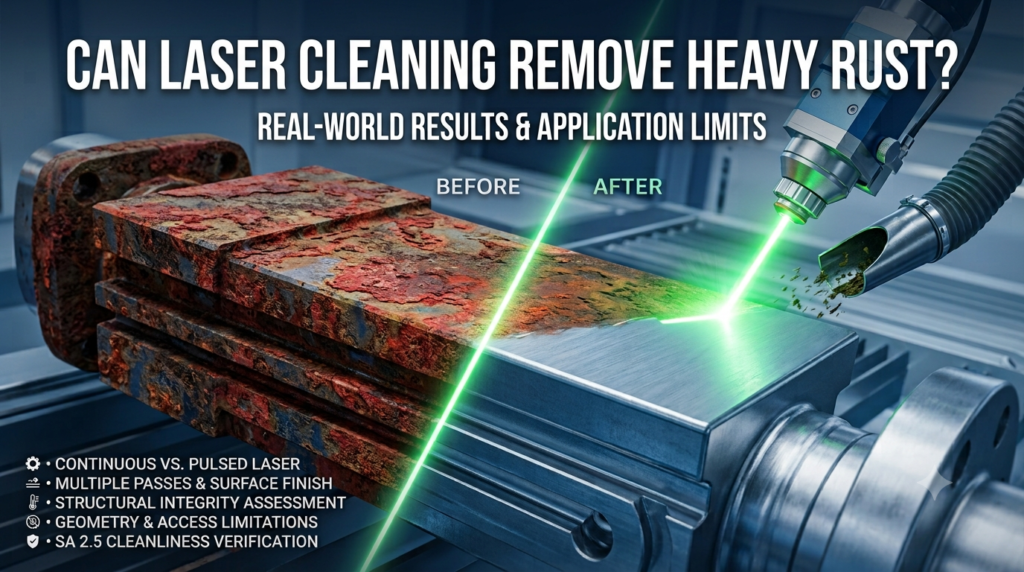
What Counts as “Heavy Rust” — and Why It Matters for Laser Cleaning
Surface rust and heavy rust behave very differently under laser cleaning, and conflating the two leads to wrong equipment choices and unrealistic expectations.
| Rust Type | Description | Typical Workpieces | Laser Cleaning Outcome |
|---|---|---|---|
| Surface rust | Thin orange layer, no base metal penetration | Sheet metal stored indoors, light outdoor exposure | Cleans well with pulsed fiber laser (100W–500W); usually one or two passes |
| Heavy rust | Thick scale, flaking layers, distinct strata | Structural steel, pipe exteriors, outdoor frames (months–years of exposure) | Cleanable in most cases; typically requires CW laser (1500W–3000W) and multiple passes |
| Pitted rust | Rust has consumed base metal, leaving craters or wall-thinning | Long-neglected equipment, submerged or buried steel | Surface corrosion products can be removed; lost metal cannot be restored — structural assessment needed before cleaning |
| Mill scale / heat scale | Dense oxide from hot rolling or welding heat | Hot-rolled steel plate, weld heat-affected zones | More adherent than atmospheric rust; removable but requires more aggressive settings and more passes |
The distinction matters because the equipment, laser mode, and number of passes required all change depending on which category you’re dealing with.
Can Laser Cleaning Remove Heavy Rust? The Short Answer
Yes — in most cases involving thick surface rust and layered scale on intact base metal, laser cleaning is effective. It typically requires a higher-power continuous-wave (CW) fiber laser and more than one pass over the surface.
The limiting factor is not usually the laser’s ability to ablate rust. The limit is whether the rust layer is mechanically loose enough that it can be detached by the laser’s thermal shock and plasma effect, versus cases where rust has deeply infiltrated the grain structure of the metal. For the latter, results are harder to predict without a sample test.
What a laser cleaning system will not do: it will not rebuild lost metal, it will not clean inside blind holes or cavities that the laser head cannot reach, and it will not produce a certified Sa 2.5 or Sa 3 surface finish without verification against your specific workpiece and acceptance standard.
What Affects How Well Heavy Rust Cleans
Several variables interact here. None of them can be answered in the abstract — they’re workpiece-specific.
Rust layer thickness and adhesion. Loose, flaking rust often clears faster than tightly bonded scale. Scale that formed at high temperature (mill scale on hot-rolled steel, for example) is denser and more adherent than atmospheric rust, and may need a different laser configuration to detach cleanly.
Base metal type. Carbon steel, stainless steel, cast iron, and weathering steel all respond differently. Cast iron in particular can be sensitive to thermal cycling during laser cleaning because of its microstructure. If you’re working with anything other than standard carbon steel, that should be part of your sample evaluation.
Laser mode: continuous vs. pulsed. This is where most buyers need a clearer picture:
| Continuous-Wave (CW) Fiber Laser | Pulsed Fiber Laser | |
|---|---|---|
| Typical power range | 1500W – 3000W | 100W – 1000W |
| How it delivers energy | Sustained beam — constant energy output | High-peak bursts — energy delivered in short pulses |
| Strength on heavy rust | High average power breaks through thick deposits efficiently | Lower average power; more passes needed for thick scale |
| Thermal control | Less precise — higher heat input to workpiece | Better controlled — lower risk of thermal distortion |
| Best suited for | Large structural steel, pipe exteriors, heavy industrial frames | Precision parts, thin sections, surfaces that can’t tolerate excess heat |
| Tradeoff | Faster throughput on heavy rust; less suitable for heat-sensitive workpieces | Safer for delicate surfaces; slower on thick rust deposits |
A high-peak-power pulsed system configured aggressively can remove heavy rust — it just requires more careful parameter management and more passes. For more on this tradeoff, see our article on pulsed vs. continuous laser cleaning.
Scanning pattern and pass count. A single pass at standard settings may not be enough for thick rust. Overlapping passes at different angles can improve coverage uniformity. The right number of passes is determined by the workpiece and target cleanliness — not by a preset formula.
Multiple Passes: What to Expect
This is something buyers don’t always anticipate. With heavy rust, one pass often reveals the scale has been disrupted but not fully removed, or that there’s a secondary rust layer beneath the first. This is normal behavior, not a sign the equipment is underperforming.
What you should expect during a sample test:
- After the first pass, visible scale should be significantly reduced or gone in most areas.
- Remaining rust or discoloration may indicate either residual corrosion products or surface oxidation from the laser process itself (which is a different issue from the original rust).
- A second or third pass, sometimes with adjusted focus or power, typically addresses remaining spots.
The key variable is your acceptance standard. “Visually clean” is not the same as “meets Sa 2 as defined by ISO 8501-1.” If your downstream process — painting, coating, welding prep — has a defined surface preparation requirement, that’s what the sample test needs to demonstrate, not just a subjective before/after comparison.
How to Judge Whether the Cleaning Result Is Acceptable
Visual inspection tells you something, but it’s not enough on its own for critical applications.
For most industrial purposes, the evaluation after laser cleaning should cover:
Rust residue. Is the surface visually free of red/brown rust? Are there dark stains that might be tightly bonded scale or thermal discoloration? These need to be distinguished — one is incomplete cleaning, the other may be an expected surface change from the laser process.
Surface condition of the base metal. Has the base metal changed in ways that affect your next process? Light surface texture from laser ablation is generally acceptable for painting. For precision-fit surfaces or surfaces that will be exposed without coating, a closer look is warranted.
Re-oxidation. Steel re-oxidizes quickly after laser cleaning, especially in humid conditions. If you’re doing surface prep before painting, the time between cleaning and primer application matters. This is process design, not a flaw in laser cleaning — but it’s something to plan for.
If your application requires documented surface cleanliness (aerospace, marine, structural), visual assessment should be backed by appropriate measurement. Laser cleaning can meet demanding surface preparation standards, but that needs to be verified for your specific workpiece, not assumed.
Where Laser Cleaning Has Practical Limits on Heavy Rust
This section tends to get left out of marketing materials, which is exactly why it’s here.
| Situation | What Laser Cleaning Can Do | What It Cannot Do |
|---|---|---|
| Through-pitted or wall-thinned metal | Remove remaining surface corrosion products | Restore lost metal or recover structural integrity |
| Enclosed geometry (pipe interiors, blind pockets) | Clean surfaces the laser head can physically reach | Access areas with no line-of-sight — extraction also needs access |
| Extremely thick mill scale or weld heat-scale | Remove the scale with sufficient passes and power | Guarantee results without a sample test on your specific material |
| Heavy rust on thin or heat-sensitive sections | Remove rust using pulsed parameters with controlled heat input | Combine high-power CW speed with thin-sheet safety simultaneously — there is a real tradeoff |
| Rust that has penetrated grain structure | Ablate surface oxides | Predictably remove deeply infiltrated corrosion without testing |
If your workpiece falls into more than one of these categories — for example, pitted rust on a thin-walled section — the constraints stack. A sample test on the actual workpiece is the only honest way to determine whether laser cleaning meets your acceptance criteria.
What a Useful Sample Test Should Include
If you’re evaluating laser cleaning for a heavy rust application, a useful test needs to be documented well enough to draw real conclusions:
| What to Record | Why It Matters |
|---|---|
| Base material and thickness | Different metals and gauges respond differently; results don’t transfer between them |
| Rust condition before cleaning | “Heavy rust” means different things — describe or photograph the actual state |
| Equipment used: laser mode and power level | A test result from a 3000W CW system doesn’t predict what a 200W pulsed system will achieve |
| Number of passes and any parameter changes between passes | One-pass results and three-pass results are not the same data point |
| Target cleanliness standard | “Visually clean” vs. “Sa 2.5 per ISO 8501-1” vs. “ready for primer” are different acceptance criteria |
| Actual result: before/after photos at the same angle and lighting | Angle and lighting changes can make results look better or worse than they are |
| Area and time if efficiency is relevant | Record actual area processed and elapsed time — not a single spot under ideal conditions |
Without this structure, a demo video showing rust being removed tells you very little about whether the process works for your specific workpiece and acceptance criteria.
Equipment Used for Heavy Rust Removal
For heavy rust on carbon steel structures, industrial frames, or large metal components, continuous-wave fiber laser systems are the typical starting point. Lumax offers CW cleaning systems from 1500W to 3000W in cabinet and handheld configurations.
For mixed workloads — some heavy rust, some precision parts or lighter surface prep — pulsed laser systems in the 300W–1000W range handle the lighter work more controllably, at the cost of throughput on thick deposits.
The right starting point depends on your workpiece. If you have a specific application in mind, send us the workpiece details — material, rust condition, target cleanliness, and approximate area — and we can help assess whether a sample test makes sense and which configuration to use.
Browse our laser cleaning machine range for an overview of available configurations.
FAQ
Can laser cleaning achieve Sa 2.5 or Sa 3 surface cleanliness on heavily rusted steel?
It can, but this needs to be verified for your specific workpiece. Sa 2.5 and Sa 3 are defined cleanliness grades (ISO 8501-1) that require documented assessment, not visual estimation. Some heavily rusted surfaces can reach these grades after multiple laser passes; others, particularly where rust has deeply penetrated the grain structure, may not. A sample test with before/after photography and surface evaluation is the right way to establish this for your application.
How many passes does heavy rust typically require?
There’s no universal number. One pass removes most of the loose rust in many cases; a second pass addresses residual spots or tightly bonded scale. Some extreme cases need more. The honest answer is that this is workpiece-dependent, and the only way to know for your material is to test it.
Does laser cleaning work on cast iron with heavy rust?
Cast iron can be laser cleaned, but it requires more caution than carbon steel because of its graphite microstructure and sensitivity to thermal shock. Heavy rust on cast iron should be approached with controlled pulsed parameters and a careful sample evaluation before committing to a process. We wouldn’t recommend applying high-power continuous settings to cast iron without a prior test.
Will laser cleaning remove rust from inside a pipe or enclosed space?
Only where the laser head and fume extraction can physically access. Interior surfaces of pipes, deep pockets, or blind cavities generally cannot be reached with standard handheld laser cleaning setups. If your application involves interior rust removal, describe the geometry when you contact us — some automated configurations can reach areas that handheld systems cannot.