
To choose a laser rust remover, start with the workpiece, not the catalog. The base metal, rust condition, required finish, cleaning area, work location, and production target determine what should be tested. Send those six items before asking for a quote; otherwise, any recommendation based only on wattage is an educated guess.
At Lumax Laser, we treat selection as an application-matching process. A compact machine can be convenient and still be wrong for the surface requirement. A higher-power option can look productive on paper and still be a poor fit for access, power supply, or finish control. The goal is not to choose the largest number. It is to define a setup that can reach an agreed result on your actual part.
Start With the Base Metal and Part Geometry
“Metal” is not a complete material description. Tell us whether the part is carbon steel, stainless steel, cast iron, aluminum, copper alloy, or another material. If you know the grade, include it. Also state the approximate section thickness, because a thin panel, a heavy casting, and a sharp edge do not present the same process risk.
Geometry matters as much as material. Flat plate gives the operator a clear working angle. Corners, narrow grooves, threads, weld toes, stamped ribs, and internal cavities can restrict access or require a different scan approach. Mark the exact area to be cleaned on a photo. If the laser must reach behind a flange or into a recess, include a side view and a measurement.
List anything that must remain untouched: machined dimensions, engraved marks, a protective coating next to the rust, a polished face, a seal, an adhesive joint, or a heat-sensitive component. If the part is an assembly rather than bare metal, identify nearby materials. We cannot judge the cleaning boundary from a close-up of rust alone.
Before selecting equipment, answer three material questions:
- What is the base metal and, if known, its grade?
- What are the thinnest section and the most difficult-to-reach feature?
- Which surfaces, markings, or adjacent materials must be preserved?
Describe the Rust Layer Before Comparing Machines
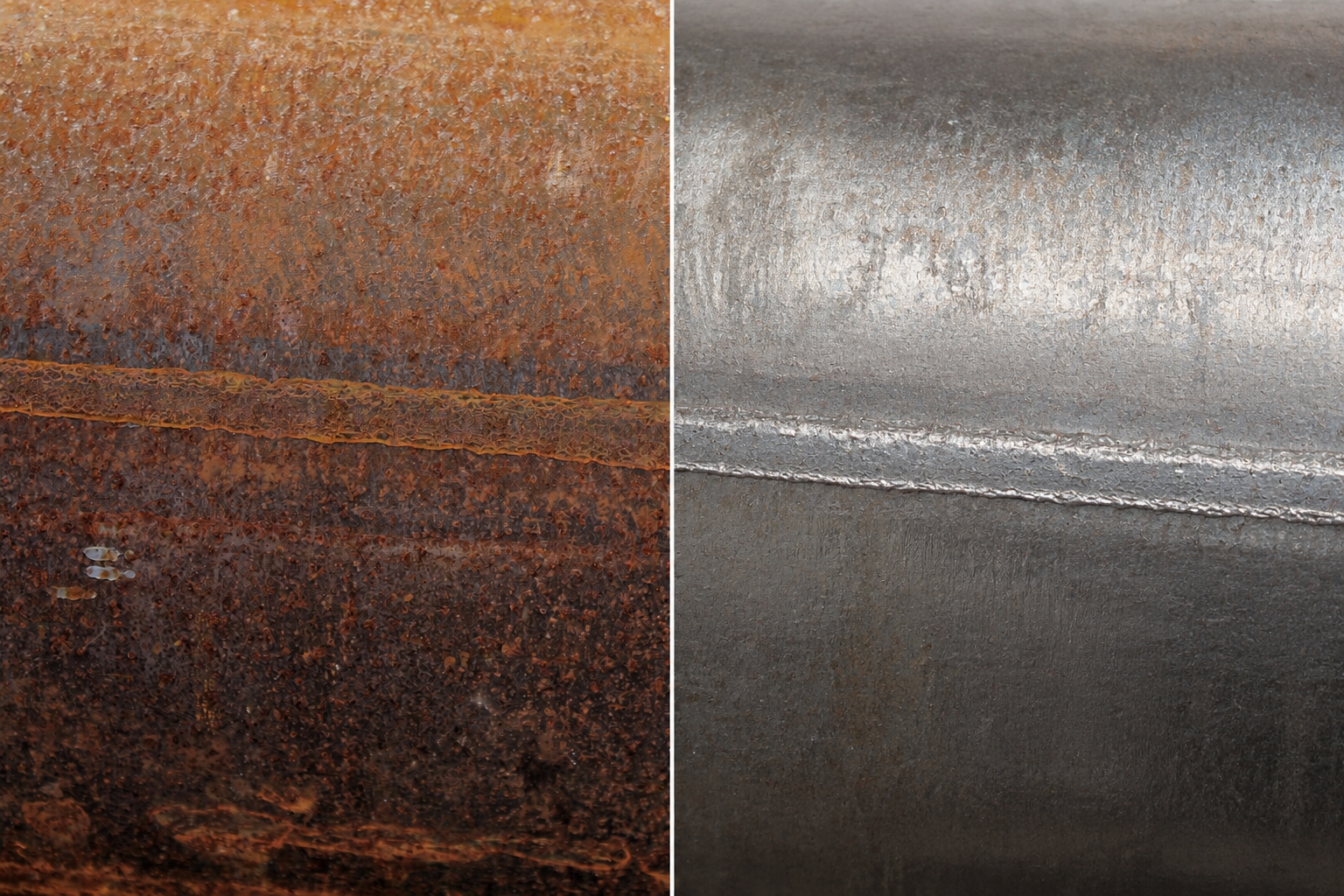
Rust severity should be described by condition, not only by color. A light orange film after short-term exposure is different from tightly bonded corrosion, lifting scale, or a surface that is already deeply pitted. Laser cleaning can remove corrosion products, but it cannot rebuild metal that corrosion has already consumed.
Use the following terms when they fit the part:
- Flash rust: a thin, recent film with little visible buildup.
- Bonded rust: a more established layer that remains attached to the surface.
- Heavy scale: thick or flaking corrosion products, often with uneven buildup.
- Pitting: local cavities in the base metal. Cleaning may reveal the pits more clearly; it does not erase them. Photos should show both the whole part and a close-up with a ruler or another scale reference. If the corrosion varies, photograph the lightest and heaviest areas. Note whether oil, paint, grease, salt residue, or dirt sits on top of the rust, because a mixed layer is not the same cleaning task as dry rust alone.
Define the Finish You Need After Rust Removal
“Remove the rust” still leaves a key question unanswered: what must the part be ready for next? Cleaning for visual inspection is not automatically the same as preparation for welding, bonding, or recoating. A buyer who wants a uniform cosmetic appearance may judge the result differently from a maintenance team that only needs loose corrosion removed before inspection.
Write the acceptance condition before the sample test. Useful criteria include the amount of visible rust allowed, whether remaining discoloration is acceptable, whether the existing surface texture must be preserved, and whether adjacent paint or markings must remain. If a downstream process specifies surface cleanliness, roughness, or contamination limits, share that requirement rather than replacing it with a photograph marked “clean.”
For thin sections, finished faces, precision components, or parts with coatings that must remain, define what counts as unacceptable change. That may include distortion, visible melt marks, altered texture, loss of an edge, or removal outside the target area. Read Does Laser Cleaning Damage Metal? for the inspection questions that should be settled before a test.
Match the Machine Format to the Actual Work Route
After the workpiece and finish are defined, compare the physical setup. Backpack, suitcase, and cabinet designs describe how the equipment is carried, protected, and positioned. They do not, by themselves, prove that a machine is suitable for a particular metal or rust layer.
A useful comparison looks at the complete job: how the machine reaches the part, where it is placed during cleaning, what power is available, how the operator routes the cable, and how the work area handles fumes and particles. Ask for the weight of the complete transport set, not only one module. Confirm dimensions, cable reach, input power, cooling arrangement, and included accessories for the exact configuration quoted.
| Form factor | Best question | Check on site | Do not assume |
|---|---|---|---|
| Backpack | How often is it carried? | Routes, stairs, access | Battery operation |
| Suitcase | How is it moved? | Storage and floor space | Same total weight |
| Cabinet | Can it stay near the job? | Power and clearance | Highest power is best |
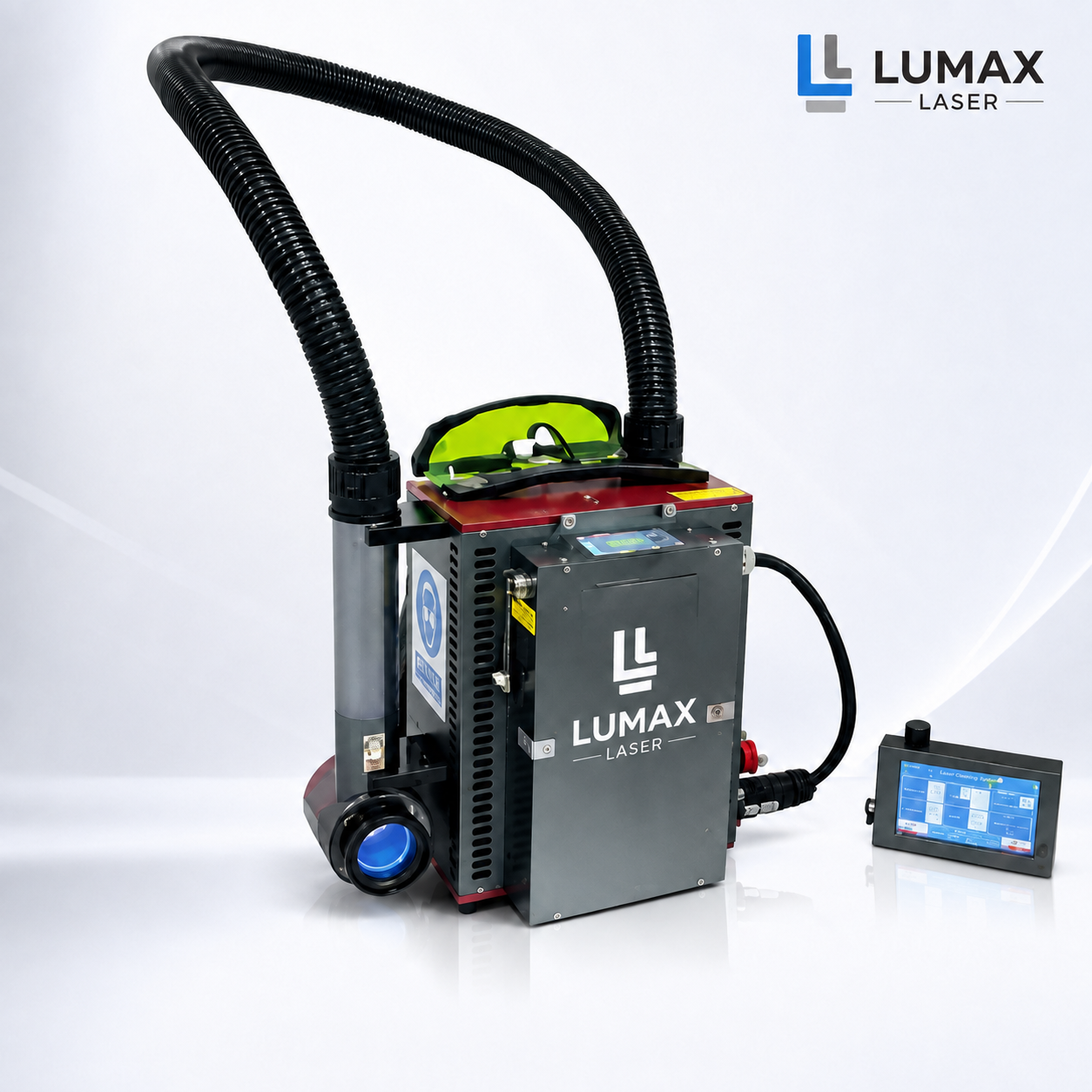
If a compact configuration is relevant, use the 200W portable laser cleaning machine as one product reference, then compare its stated configuration with your workpiece and site requirements. Other formats are listed in our laser cleaning machine range. It is not a default recommendation for every rust-removal job.
Send Six Facts Before You Request a Quote
A useful inquiry gives our sales and technical teams enough context to recommend a configuration and design a test. Copy the six items below into your message. Short, factual answers are better than a long description that omits the workpiece conditions.
| Item | Send this | Why it matters |
|---|---|---|
| 1. Base metal | Material, grade, thickness | Defines test boundary |
| 2. Rust layer | Type, severity, mixed residue | Defines removal task |
| 3. Cleaning area | Dimensions and daily quantity | Sizes the workload |
| 4. Required finish | Next process and acceptance | Defines the endpoint |
| 5. Work location | Access, power, ventilation | Shapes the setup |
| 6. Production target | Parts per shift or cycle goal | Frames the trial |
For the cleaning area, give dimensions rather than “small” or “large.” For production demand, separate occasional maintenance from repeated batch work. If a cycle target exists, state whether it includes loading, positioning, inspection, and cleanup or only laser-on time. We do not present a cleaning-speed figure without comparable test conditions.
A complete request can be as simple as: “Carbon-steel brackets, 4 mm thick, with bonded rust and some flaking areas; 300 × 200 mm per part; clean for inspection before recoating; indoor workstation with three-phase power and local extraction; 80 parts per shift.” Add photos and the finish requirement. This is an example of the information format, not a machine recommendation or a performance claim.
| Send the six items with clear photos. We will use them to recommend a configuration and define what a representative sample test must prove before purchase. |
|---|
Use a Sample Test to Verify the Recommendation
A sample test should answer a purchasing question, not merely produce a dramatic video. Use an actual part or a representative coupon with the same base metal, rust condition, and geometry. If the part has both light and heavy corrosion, include both areas. Agree on the finish and inspection method before the test starts.
Ask the supplier to document:
- The workpiece material, dimensions, and initial surface condition.
- The exact machine, cleaning head, and configuration used.
- The treated area and the number of passes or repeated scans.
- The agreed endpoint and how the cleaned surface was inspected.
- The handling time outside laser-on time when cycle performance matters. Evaluate more than visible rust removal. Check whether the laser reached corners and recessed features, whether adjacent areas remained within the agreed boundary, whether the result is consistent across the part, and whether the part is ready for its next process. If roughness, coating adhesion, dimensional control, or another measurable property is critical, use the inspection method required by your process.
Finally, compare the quote with the tested setup. The quoted machine, cleaning head, cable, cooling arrangement, power requirements, and accessories should match what was demonstrated or clearly explain any change. A meaningful quote identifies what is included, what is optional, and which workpiece result the proposed configuration has been selected to achieve.
FAQ
Which laser rust remover power should I choose?
Do not choose by wattage alone. Base metal, rust condition, required finish, working area, access, and production target all affect the decision. Compare power only after the laser type and the rest of the configuration are clear, then validate the choice on a representative sample.
Can one laser rust remover clean different metals and rust levels?
A machine can be evaluated for more than one workpiece, but each material and surface condition needs its own tested settings and acceptance criteria. A process used on heavy steel should not be assumed suitable for a thin section, finished face, or assembly with adjacent coatings. Test each important workpiece family separately.
Should I choose a backpack, suitcase, or cabinet laser cleaner?
Choose the form factor from the actual work route. Consider carrying distance, stairs, floor space, storage, cable reach, available power, ventilation, and how often the unit moves. Then confirm that the exact laser configuration can meet the surface requirement; the enclosure shape is not a performance guarantee.
How do I know whether laser cleaning will change the metal surface?
Define acceptable surface change first, then inspect a controlled sample made from the same material and condition as the production part. Visual checks may suit some maintenance tasks, while critical parts may require roughness, dimensional, or other process-specific inspection. Avoid unconditional “zero damage” claims.
SEO
- SEO Title(≤60 字符,含焦点词):How to Choose a Laser Rust Remover for Your Workpiece
- Meta Description(150–160 字符,含焦点词):How to choose a laser rust remover: match metal, rust condition, finish, workspace and output. Send the six items below for a practical model recommendation.
- Slug:how-to-choose-laser-rust-remover
- Focus keyword:how to choose a laser rust remover
- Tags:how to choose a laser rust remover, laser cleaning