
Choose pulsed laser cleaning when the required finish is sensitive and the process window must be tightly controlled. Choose continuous-wave (CW) cleaning as the first candidate when the job is large-area, heavy removal and the base material can accept more heat input. Neither type is automatically better. The right decision depends on the substrate, contaminant, required finish, workload, access and the result of a controlled sample test—not wattage alone.
What actually differs between pulsed and continuous laser cleaning
A pulsed laser delivers energy in short, separated bursts. A continuous-wave laser delivers an uninterrupted beam while it is switched on. That timing changes how energy is deposited at the workpiece, even when two machines display an average-power value in watts. Pulse energy, pulse duration, repetition rate, beam profile, spot size, scan pattern and travel speed can all affect the interaction at the surface.
This is why a comparison based only on “200 W versus 1,500 W,” for example, is incomplete. Average power does not describe peak power or how long the energy acts on one point. It also does not tell you whether the cleaning head, scanner and process recipe are appropriate for the coating or corrosion layer. A buyer should compare a complete process window, not a single number on a quotation.
In practical selection, pulsed systems are usually evaluated first for controlled removal where the buyer wants to preserve a defined surface condition. CW systems are usually evaluated first when removal rate over a broad area matters more and the workpiece has enough thermal tolerance. These are starting points for testing, not guarantees. Material absorption, contamination thickness, geometry and operator technique can change the outcome.
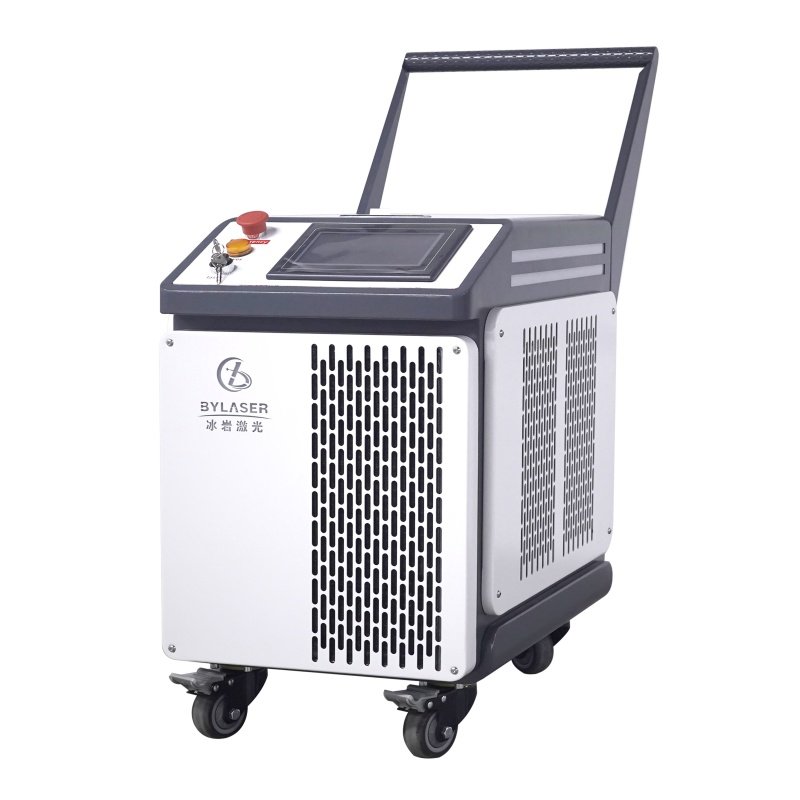
Surface requirements decide when precision matters most
Start with the acceptance standard for the cleaned part. “Remove the rust” is not specific enough. The same workpiece may need a visually clean surface, a controlled profile for bonding, an intact machined texture, a protected coating next to the target area, or dimensional stability on a thin section. Those requirements determine how narrow the usable process window must be.
Pulsed cleaning is generally the stronger candidate when the buyer needs selective removal and limited heat accumulation. Typical evaluation cases include precision tooling, textured molds, thin parts, localized coating removal and surfaces that will be inspected for color, roughness or geometry after cleaning. The result still depends on settings and technique; “pulsed” does not mean “zero damage.”
Before a test, define what must remain unchanged:
- Base material and any plating, coating or treatment that must remain.
- Permitted change in color, gloss, roughness, edge condition or dimensions.
- Areas that must not be exposed to the beam.
- Inspection method, such as visual criteria, roughness measurement or microscopy. If substrate protection is the main concern, read our related guide, Does Laser Rust Removal Damage Metal? It explains why material, surface condition and test settings must be reviewed together rather than relying on a blanket “no damage” claim.
Workload and rust thickness decide when throughput matters most
When the job involves thick scale, heavy rust or a large accessible surface, removal capacity and cycle time may dominate the decision. A CW machine can be a practical candidate because continuous energy delivery is often paired with higher average power and broad-area cleaning. The trade-off is that heat input and the risk of changing the substrate surface must be evaluated carefully.
Do not compare speed figures taken from unrelated demonstrations. Cleaning rate depends on the base metal, contaminant type, layer thickness, adhesion, target endpoint, scan width, overlap, number of passes and time spent repositioning the workpiece. A video showing rapid removal of loose corrosion does not prove the same rate on tightly bonded scale or paint. We do not recommend a cleaning-speed figure until the test conditions and acceptance endpoint are stated.
Workload also includes more than beam-on time. Buyers should record setup, focusing, part handling, access around corners, fume extraction, pauses for inspection and any rework. A machine that removes material quickly but requires repeated inspection or leaves an unacceptable finish may not produce the best overall cycle.
For mixed workloads, do not force one answer across every part. A plant may need precise pulsed cleaning for molds or finished components and a different process for large structural steel. Group workpieces by substrate, contamination and acceptance standard before selecting equipment.
Pulsed vs continuous laser cleaning at a glance
| Comparison point | Pulsed laser | Continuous-wave laser |
|---|---|---|
| Energy delivery | Separated short pulses | Uninterrupted output |
| Heat input | Usually easier to limit | Usually higher accumulation risk |
| Process priority | Selective, finish-sensitive work | Broad-area, heavy removal |
| Typical shortlist | Molds, thin parts, local removal | Heavy rust, scale, large areas |
| Surface profile | Can preserve more detail | May alter finish if overexposed |
| Key variables | Pulse energy, width, frequency | Power, spot, scan speed |
| Decision proof | Controlled sample + inspection | Controlled sample + inspection |
The table is a screening tool, not a substitute for a sample test. A pulsed system with unsuitable settings can still mark a surface, while a carefully tested CW process may be acceptable on a robust part. The buyer’s acceptance criteria remain the deciding factor.
How to run a fair sample test
A useful test compares the machines under the same job definition. It does not compare two supplier videos, different rust layers or different definitions of “clean.” Send representative parts whenever possible. If only coupons are available, document how they differ from production parts.
- Document the incoming part. Record the alloy or grade if known, thickness, surface treatment, geometry and heat-sensitive features. Photograph the contaminant and note whether it is loose, bonded, layered or mixed.
- Define the endpoint before cleaning. State whether the goal is visual rust removal, coating removal, preparation for welding or bonding, or preservation of a specific texture. Agree on what counts as incomplete cleaning and what counts as unacceptable surface change.
- Control the comparison area. Use comparable areas from the same part or from parts with the same history. Mark the test area so that time, passes and inspection results can be matched to the correct process.
- Record the complete setup. Document laser type, machine model, relevant settings, scan pattern, working distance, passes, operator method and extraction arrangement. Any model-specific values remain subject to the approved data sheet and test record.
- Measure more than beam-on time. Record setup, cleaning, repositioning, inspection and rework separately. This prevents a fast demonstration pass from being mistaken for a complete production cycle.
- Inspect against the agreed standard. Check residual contamination and the preserved substrate condition. Use the measurement method the application requires rather than relying only on a distant photograph. If the pulsed and CW tests use different settings, that is not automatically unfair; each machine should be optimized within safe, approved limits. What must remain constant is the workpiece condition, target endpoint and inspection method. The report should make every difference visible so the buyer can judge the trade-off.
Use this selection checklist before requesting a quote
A supplier can recommend a laser type only when the application is described clearly. Prepare the following information before asking for a model or quotation:
- Base metal: material grade, thickness and any heat treatment or plating.
- Contaminant: rust, oxide, paint, oil, residue or a combination; include layer condition and photographs.
- Required finish: what must be removed and what must remain unchanged.
- Workload: part size, area per part, parts per shift and expected operating pattern.
- Geometry and access: flat, curved, recessed, internal, near edges or close to protected areas.
- Site constraints: available power, ventilation or extraction, mobility and production-space limits.
- Acceptance method: visual standard, roughness, dimensions, coating integrity or downstream-process result. Shortlist a pulsed system first when finish preservation, local control or sensitivity to accumulated heat is central to acceptance. Shortlist a CW system first when the parts are robust, the contamination is heavy and large-area throughput is the main requirement. If the same facility has both types of work, evaluate them as separate applications.
For a 200 W portable product option, review the Lumax Laser 200W portable laser cleaning machine. To compare output classes and formats, browse the full laser cleaning machine range. Use the current data sheet and a workpiece test to confirm whether that model fits your material, finish and workload. Do not treat the 200 W rating alone as proof of suitability.
Send us your base metal, rust condition and required surface finish — we will recommend a laser type and a sample-test plan.
FAQ
Is pulsed laser cleaning always safer for metal surfaces?
No. Pulsed output can offer a more controllable starting point for finish-sensitive work, but incorrect settings, focusing, overlap or dwell can still alter a surface. The substrate, contaminant and acceptance standard must be tested together.
Is continuous laser cleaning always faster?
No. CW systems are often considered for high-throughput, broad-area removal, but actual cleaning time depends on contamination thickness, adhesion, target endpoint, scan strategy, access, setup and rework. Compare both processes under the same documented test conditions.
Can I choose between pulsed and continuous cleaning by wattage?
No. Wattage states average power, not the full energy-delivery pattern or process window. For pulsed systems, pulse energy, duration and repetition rate also matter; for both types, spot size, scan pattern, speed and workpiece response must be considered.
What should I send Lumax Laser for a recommendation?
Send the base-metal type, part dimensions, contamination description, close-up photographs, required finish, workload, access limits and available utilities. A representative sample is the best basis for a test plan and model recommendation.